Buying stainless steel plate for an industrial project is not only a question of grade and ton price. Buyers also need to confirm thickness tolerance, finish, cutting route, certificate requirements, and delivery conditions before a quotation becomes commercially meaningful. When those details are missed at the enquiry stage, the result is usually a longer quote cycle, harder supplier comparison, and more purchasing risk after the material is already in production.
For fabricators, EPC contractors, stockists, and equipment manufacturers, the best approach is to treat stainless steel plate sourcing as both a technical decision and a supply-chain decision. The right material should fit the service environment, match downstream processing, and arrive with documentation that supports inspection, export, and final use. This guide explains what industrial buyers should check before placing a stainless steel plate order.
What Buyers Should Confirm Before Asking for Stainless Steel Plate Price
Many plate enquiries begin with only a grade and thickness, but that is rarely enough to generate a reliable commercial offer. A supplier quoting 304 stainless steel plate in a general stock finish may not be quoting the same product basis as another supplier offering cut-to-size 316 plate with tighter tolerance and full traceability. The numbers may look comparable while the supply scope is not.
Before requesting stainless steel plate price, buyers should clarify the intended use. Plate for tank fabrication, food-processing equipment, water treatment skids, architectural fabrication, or chemical service can carry very different requirements. A good RFQ gives the supplier enough information to quote the correct product the first time and helps the buyer avoid repeated clarification rounds.
304 vs 316 Stainless Steel Plate for Industrial Buying
304不锈钢板 remains one of the most widely used commercial choices because it offers a practical balance of corrosion resistance, formability, and availability. It is commonly selected for general fabrication, machine covers, food-related equipment frames, indoor utility applications, and many processing environments where chloride exposure is limited or moderate.
316不锈钢板 is more often chosen when the operating environment is more aggressive. Buyers frequently prefer 316 for coastal installations, chemical handling systems, marine-adjacent projects, pharmaceutical equipment, and applications where improved pitting resistance is important. The higher initial material cost can be commercially justified when replacement risk, downtime, or corrosion-related maintenance would be more expensive later.
Low-carbon versions such as 304L or 316L may also be relevant when welding performance matters. In practice, buyers should describe the service conditions instead of defaulting automatically to one grade. That gives the supplier a better basis for confirming whether standard austenitic plate is sufficient or whether a more specialized material should be considered.
Finish, Thickness, and Flatness Can Change the Whole Quote
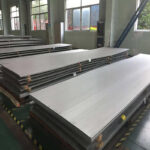
Finish selection has a direct effect on both fabrication practicality and price. Hot rolled No.1 stainless steel plate is widely used for heavier industrial fabrication, pressure-related components, and structural applications where a rougher industrial finish is acceptable. Smoother finishes may be more suitable where appearance, hygiene, or refined downstream processing is more important.
Thickness tolerance and flatness also deserve attention. If the material will be laser cut into precision parts, machined, bent, or fitted into assemblies with tight dimensional expectations, inconsistent flatness can create scrap, fit-up problems, or extra workshop labor. These issues cost more to correct after arrival than they do to address during quotation.
A buyer comparing offers from different stainless steel plate suppliers should therefore confirm whether the price basis includes only nominal dimensions or whether tighter control, extra inspection, or specific finish expectations are already included.
What to Include in a Stainless Steel Plate RFQ
A strong RFQ shortens lead time and improves price accuracy. It also makes supplier offers easier to compare on the same technical basis. For a commercial quotation, buyers should ideally provide:
- Grade, such as 304, 304L, 316, 316L, or another required alloy
- Plate thickness, width, length, and quantity
- Required finish, such as No.1, 2B, BA, or another specified surface
- Applicable standard or project specification
- Any cut-to-size, edge condition, or processing requirement
- Documentation needs such as mill test certificate or EN 10204 3.1
- Packing, marking, and destination port details
If the order is project-based rather than routine stock replenishment, it is also useful to state the actual application. That allows the supplier to flag mismatches early, suggest workable alternatives, and quote the most realistic lead time.
How Buyers Can Reduce Supply Risk on Export Orders
For international stainless steel plate sourcing, traceability and communication matter as much as headline price. Buyers should confirm mill origin, available certificates, realistic stock or production lead time, and inspection arrangements before payment terms are finalized. If third-party inspection, special marking, or mixed-size packing is required, it should be agreed clearly before production starts.
Commercial terms deserve the same discipline. Confirm Incoterms, seaworthy packing, pallet or skid method, piece marking, and whether multiple thicknesses will ship together or in separate lots. On recurring projects, a supplier that understands your documentation and shipping pattern can reduce repeat coordination work and help stabilize procurement planning.
When a Stainless Steel Plate Supplier Adds More Value Than a Spot Quote
Spot purchasing may work for simple replenishment orders, but many industrial buyers benefit from a supplier that can review the specification, identify missing details, and coordinate the material with processing and export handling. This is especially useful when the enquiry includes mixed sizes, tight deadlines, or fabrication requirements that make substitution costly.
A capable stainless steel plate supplier should be able to discuss commercial feasibility as well as material suitability. That means explaining availability, highlighting cost implications of unusual finishes or dimensions, and helping the buyer compare stock material against custom supply routes where necessary.
Request a Stainless Steel Plate Quote
If you are sourcing stainless steel plate for tanks, fabrication, processing equipment, construction, or industrial distribution, send your grade, size list, finish, quantity, and delivery destination for a practical quotation. Clear project information helps reduce revisions, improve price accuracy, and shorten the supply cycle.
For a direct quotation or enquiry, contact SOROYA PTE. LTD. by email at nancy@soroya.com.sg 或 WhatsApp +65 8058 3416. Share your target specification, quantity, and destination, and we can help review the most workable stainless steel plate supply option for your requirement.
关于 SOROYA PTE. LTD.
SOROYA PTE. LTD. 是一家总部位于新加坡的供应商,致力于满足国际不锈钢采购及供应链需求。.
总经理:南希
总经理电子邮箱:nancy@soroya.com.sg
WhatsApp:+65 8058 3416
地址:新加坡罗宾逊路14号,#08-01A室,远东金融大厦,048545