Choosing between 304 and 316 stainless steel sheet or plate is one of the most common grade decisions a B2B buyer makes, and it is driven almost entirely by the environment the material will face — not by price alone. Both are austenitic, non-magnetic and easy to form, but 316 adds molybdenum that changes how the metal behaves against chlorides. This guide explains the practical difference, when 304 is enough, when 316L is required, and what to write on your RFQ.
What separates 304 from 316
Both grades belong to the 18 chromium / 8 nickel austenitic family. The key alloying difference is molybdenum (Mo):
- 304 / 304L (UNS S30400 / S30403) — roughly 18% chromium and 8% nickel, with no deliberate molybdenum. It resists atmospheric oxidation, fresh water and mild food acids, and is the default general-purpose grade.
- 316 / 316L (UNS S31600 / S31603) — keeps the chromium-nickel base and adds about 2–3% molybdenum. That molybdenum stabilizes the passive chromium-oxide film against local breakdown.
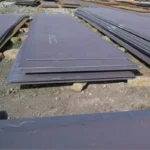
For the physical forms — sheet vs plate thickness, finishes and tolerances — read our stainless steel sheet vs plate buyer guide; this article focuses only on grade selection.
Why molybdenum matters: chloride pitting and crevice corrosion
Stainless steel protects itself with a thin invisible chromium-oxide film that self-heals in oxygen. In most indoor and dry conditions that film holds on 304. The failure mode that breaks it down is chloride attack: salt, de-icing brine, seawater splash, bleach, pickling acids and certain process chemicals locally puncture the film, producing pitting and crevice corrosion that starts tiny and grows underneath the surface. Molybdenum in 316 makes the film far harder to puncture in these chloride environments.
Buyers sometimes compare grades using the pitting resistance equivalent number (PREN = Cr + 3.3 Mo + 16 N), a rough screening index rather than a pass/fail limit; 316 consistently scores higher than 304 because of its molybdenum. Always confirm the actual service conditions rather than relying on a single number.
When 304 / 304L is the right choice
Specify 304 or 304L when the part stays in a mild, dry or indoor environment:
- Indoor architectural panels, railings, trim and elevator interiors.
- Freshwater tanks, sinks, kitchen worktops and general food-contact equipment without salt exposure.
- Appliances, shelving, enclosures and decorative fabrication.
- Any application where the lower material cost matters and chlorides are absent.
Choose the low-carbon 304L version when the plate or sheet will be welded, because the lower carbon reduces chromium carbide precipitation (sensitization) in the weld heat-affected zone.
When 316 / 316L is required
Move to 316 or 316L when chlorides, moisture or chemicals are present:
- Coastal and marine exposure, seawater splash, pools and salt-air outdoor structures.
- Chemical processing, pharmaceutical and laboratory equipment, and heat-exchanger plates.
- Food and dairy lines using salt brines, pickling or sanitizing chemicals.
- Outdoor fixtures near roads treated with de-icing salt.
Use 316L for welded fabrication in these duties; the low-carbon variant resists sensitization just as 304L does, while retaining the molybdenum benefit. Note that 316 resists chlorides better than 304, but it is not immune to every chemical — highly acidic, hot or concentrated chloride service may call for a higher-alloy grade, so disclose the exact media on your inquiry.
Standards and material verification
Sheet and plate of both grades are commonly ordered to ASTM A240 (chromium and chromium-nickel stainless plate, sheet and strip for pressure vessels and general applications), with UNS S30400/S31600 identifying the alloy family. Require a mill test certificate (EN 10204 3.1) stating grade, chemistry and mechanical properties — see our 钢厂检验证书买方核对清单 for what to verify on it. Mill certificates also confirm whether the material is 304, 304L, 316 or 316L, which visual inspection cannot reliably do.
Buyer’s RFQ checklist for 304 vs 316 sheet and plate
Send these details on every inquiry so the supplier can confirm the grade against your environment:
- Form: sheet or plate, with exact thickness, width and length.
- Grade: 304, 304L, 316 or 316L, and whether welding is planned (favors the L version).
- Service environment: indoor dry, freshwater, coastal/salt, chemical or food brine.
- Any media, temperature and exposure period the material contacts.
- Standard: ASTM A240, finish (2B, No. 4, No. 1) and required mill test certificate.
- Quantity and delivery location.
应避免的常见错误
- Specifying 304 for a coastal or chloride environment where pitting will appear within months.
- Paying for 316 on a dry indoor bracket where 304 would perform adequately.
- Ordering non-L grades for heavy welding and losing corrosion resistance at the weld.
- Guessing the grade from appearance — 304 and 316 look identical without a certificate.
Send us your application, environment and drawing, and SOROYA will help match the correct 304/304L or 316/316L sheet or plate and respond with a quotation and supporting documentation.
SOROYA PTE. LTD.
Email:nancy@soroya.com.sg
WhatsApp:+65 8058 3416