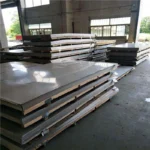
Stainless steel sheet is one of the most widely purchased flat-rolled products in the metal industry, yet buyers often overlook a critical specification: the surface finish. The finish determines not only the visual appearance but also corrosion resistance, cleanability, welding behavior and fabrication cost. This guide explains the common stainless steel sheet finishes available on the market — 2B, BA, No.4 brushed, HL hairline and 8K mirror — their typical roughness values, production methods, best applications and what to specify on your next RFQ.
Why stainless steel sheet finish matters
Unlike carbon steel, stainless steel depends on a thin, passive chromium-rich oxide film for corrosion resistance. The mill finish is the starting surface condition as delivered from the rolling mill. A properly specified finish:
- Provides a uniform, passive surface that resists pitting and staining.
- Reduces fabrication effort — a No.4 sheet may arrive ready for architectural use without additional grinding.
- Improves cleanability for food, pharmaceutical and sanitary equipment.
- Avoids costly secondary polishing operations that add lead time.
1. 2B — cold-rolled, annealed and pickled
2B is the most common and economical mill finish for stainless steel sheet. After cold rolling, the coil is annealed in a protective atmosphere and then pickled in acid to remove scale. The result is a smooth, matte, silver-grey surface with a low to moderate reflectivity.
Typical Ra: 0.1 – 0.5 μm.
Standard: ASTM A480 / EN 10088-2 / JIS G4304.
Best for: general industrial applications, tanks, structural components, kitchen equipment, automotive trim blanks and as a substrate for further polishing.
2. BA — bright annealed
Bright annealed (BA) sheet is cold-rolled and then annealed in a high-vacuum or hydrogen atmosphere, which prevents oxidation and produces a brighter, more reflective surface without pickling. It is smoother than 2B and commonly used where a clean, semi-reflective appearance is required without additional finishing.
Typical Ra: 0.05 – 0.2 μm.
Best for: domestic appliances, elevator interiors, lighting reflectors, decorative trim, and as a base for mirror polishing.
3. No.4 — brushed / directional finish
No.4 is produced by grinding the sheet with a fine abrasive belt (typically 120–240 grit), creating a uniform, directional brushed texture. It is the standard finish for commercial kitchen countertops, hospital equipment, architectural cladding and appliance panels.
Typical Ra: 0.4 – 1.2 μm.
Best for: kitchen equipment, restaurant surfaces, architectural wall panels, elevators and luggage handling systems.
4. HL — hairline finish
HL (hairline) is a finer, longer-line brushed finish than No.4, produced with finer abrasive belts (often 300–400 grit). The texture is subtler and more elegant, making it popular for architectural and decorative applications.
Typical Ra: 0.2 – 0.6 μm.
Best for: elevator doors, lobby cladding, decorative trim, luxury appliance faces and signage.
5. 8K — mirror polished
8K (also called No.8 or mirror) is a high-gloss reflective finish achieved by multi-stage polishing and buffing with progressively finer compounds. A true 8K sheet reflects images almost like a mirror. It is widely used for decorative surfaces, reflectors, signage and sanitary fixtures.
Typical Ra: 0.02 – 0.1 μm.
Best for: decorative panels, signage, display fixtures, furniture accents, reflectors and sanitary ware.
Quick comparison table
| Finish | Texture | Typical Ra (μm) | Relative Kosten | Common use |
|---|---|---|---|---|
| 2B | Matte, smooth | 0.1 – 0.5 | Lowest | General industry, fabrication |
| BA | Bright, semi-reflective | 0.05 – 0.2 | Low | Appliances, reflectors |
| No.4 | Directional brushed | 0.4 – 1.2 | Medium | Kitchen, architecture |
| HL | Fine hairline | 0.2 – 0.6 | Medium | Decorative, elevators |
| 8K | Mirror | 0.02 – 0.1 | Highest | Decor, reflectors |
Which grade pairs with which finish?
304 (1.4301) is the default grade for 2B, BA and No.4 sheet in indoor and mild-service environments. For outdoor architectural, coastal or chemical exposure, 316L (1.4404) with molybdenum offers better pitting resistance. Mirror finishes are available in both grades, but 316L is preferred where corrosion performance is critical alongside appearance.
RFQ checklist for buyers
When requesting stainless steel sheet, always specify:
- Grade: 304 / 304L / 316 / 316L.
- Standard: ASTM A240 / A480, EN 10088-2 or JIS G4305.
- Finish: 2B, BA, No.4, HL or 8K, with grit or Ra range if critical.
- Dimensions: thickness × width × length (e.g. 2.0 × 1219 × 2438 mm).
- Tolerance: normal or tight mill tolerance per ASTM A480.
- Edge condition: mill edge or slit edge.
- Certification: EN 10204 3.1 mill test certificate.
Need help choosing the right stainless steel sheet finish for your project? Contact SOROYA for mill-direct supply with full material certification.
SOROYA PTE. LTD.
Email: nancy@soroya.com.sg
WhatsApp: +65 8058 3416