Industrial buyers rarely have trouble finding a stainless steel plate quote. The harder part is getting a quote that actually matches the fabrication plan, surface requirement, and delivery schedule behind the enquiry. When a request only says “304 plate” or “316 plate,” suppliers often have to guess thickness tolerance, finish, cutting scope, and documentation expectations, which can lead to price revisions or unusable comparisons.
For project buyers, stockholders, equipment fabricators, and OEM sourcing teams, better results usually come from defining the technical and commercial scope before asking for price. Whether you need stainless steel plate for tanks, structural fabrication, machinery parts, or export distribution, a clear RFQ helps reduce back-and-forth and improves the quality of supplier offers.
Start with the End Use, Not Only the Grade
Many enquiries begin with grade alone, but plate buying decisions should start from the actual service condition. A plate for a decorative cover panel is not purchased on the same basis as a plate for chemical equipment, laser-cut machine parts, or welded process vessels. Buyers should tell the supplier how the material will be used, whether it will be welded or bent, and whether corrosion resistance, appearance, flatness, or mechanical performance is the main priority.
This is especially important when the order may involve secondary processing. If the plate will be cut into blanks, polished, drilled, or formed after delivery, the supplier should understand that from the start. Good sourcing decisions come from matching the material condition to downstream production instead of treating all plate as a commodity line item.
Choose 304 or 316 Based on Environment and Cost Exposure
304 stainless steel plate remains a practical choice for many industrial and commercial applications because it offers a strong balance of corrosion resistance, fabrication performance, and market availability. It is frequently considered for general equipment fabrication, indoor structures, food-contact components, cladding, and machinery used in relatively moderate environments.
316 stainless steel plate is more often selected where chlorides, aggressive cleaning chemicals, or marine-adjacent exposure create a tougher corrosion risk. It is commonly reviewed for coastal installations, chemical processing equipment, pharmaceutical systems, and projects where longer service life may justify a higher material cost. If welding is significant, buyers should also consider whether low-carbon variants such as 304L or 316L are more suitable for the fabrication route.
From a commercial standpoint, the correct grade is not always the cheapest available option and not always the most expensive one either. The right answer depends on the operating environment, expected life cycle, and the cost of replacement or failure after installation.
Specify Thickness, Finish, and Size Range Precisely
Plate enquiries often slow down because the supplier cannot tell whether the buyer needs sheet, plate, or cut blanks. A proper RFQ should clearly state thickness, width, length, tolerance expectations, and whether full-size mill plate or cut-to-size material is acceptable. If the project allows alternate dimensions, that flexibility should be stated because it can improve stock availability and reduce lead time.
Surface finish also affects both price and usability. Some buyers need hot rolled plate with a standard industrial finish for structural or fabrication work. Others need cold rolled or polished material where appearance, cleanliness, or tighter dimensional control matters more. If the plate will be visible in the final installation or used in hygienic service, the finish should be defined explicitly rather than assumed.
Know When Certification and Testing Matter
Not every order needs the same documentation package. Some stainless steel plate suppliers quote only on basic stock terms unless the buyer asks for mill test certificates, third-party inspection, PMI, or EN 10204 3.1 documentation. If the material is for a regulated project, export program, or end user with strict QA requirements, this should be included in the enquiry before quotation.
Testing and certification requirements can affect source selection, lead time, and final cost. The same applies to marking, traceability, and packing instructions. If these details appear only after the order is placed, the buyer may find that the original low quote does not actually cover the real supply scope.
Build an RFQ That Suppliers Can Quote on the Same Basis
A strong RFQ for stainless steel plate should make it easy for multiple suppliers to price the same requirement. Buyers should include:
- Material grade such as 304, 304L, 316, or 316L
- Thickness, width, length, and quantity by size
- Required finish such as hot rolled, pickled, 2B, or polished
- Applicable standard or specification if project-driven
- Whether full plates, cut pieces, or CNC blanks are acceptable
- Documentation requirements including MTC or EN 10204 3.1
- Packing, marking, and destination port details
- Required shipment window and Incoterm basis
When this information is provided early, suppliers can respond with clearer commercial assumptions, realistic lead times, and fewer qualification questions. That shortens the buying cycle and makes quote comparison more meaningful.
Compare Total Supply Value, Not Only the Ton Price
Two plate quotations can look similar on headline price while being very different in practical value. One supplier may be quoting ex-stock material without cutting, inspection coordination, or export packing. Another may include tighter selection, better flatness control, cut-to-size support, and documentation that reduces risk at receiving and fabrication stages.
For many buyers, especially those sourcing for production schedules, the true cost sits beyond the base plate price. Scrap rate, cutting loss, workshop efficiency, and delivery reliability can all outweigh a small difference in ton value. A quote that arrives ready for downstream use may be commercially stronger than a cheaper offer that creates rework or schedule pressure later.
Ask the Supplier Practical Commercial Questions Before Ordering
Before placing an order, buyers should confirm whether the offer is based on current stock or mill production, what rolling source assumptions apply, whether substitute dimensions may be proposed, and how long the quoted lead time remains valid. These points matter because plate availability can vary sharply by thickness and grade.
If the order is for export, buyers should also confirm packaging method, container loading assumptions, document timing, and whether partial shipments are possible. A capable stainless steel plate supplier should be able to explain these issues directly and help the buyer avoid surprises in logistics or fabrication planning.
Request a Stainless Steel Plate Quotation
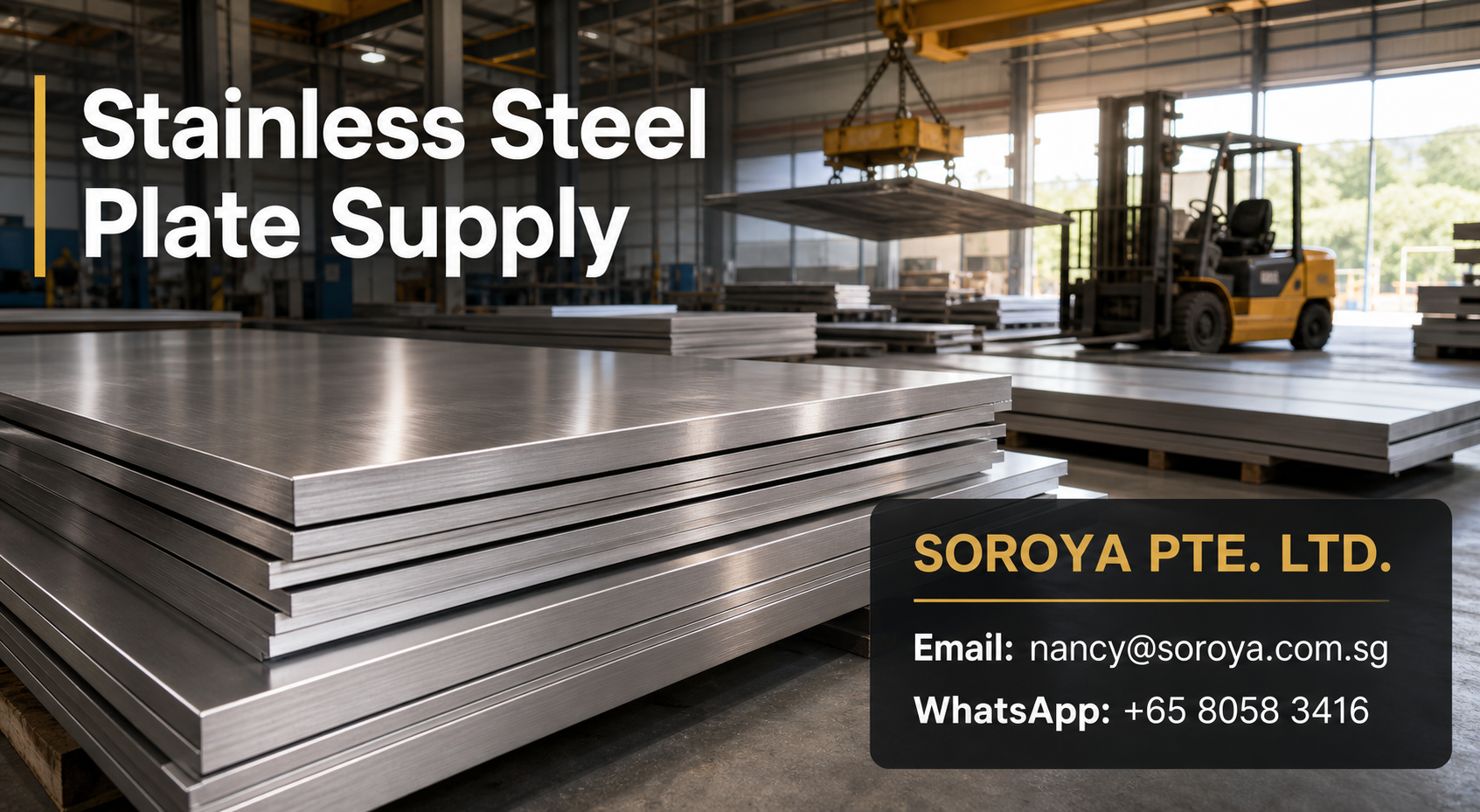
If you are sourcing stainless steel plate for equipment fabrication, structural use, tank work, machining, or project distribution, send your grade, thickness range, finish, dimensions, quantity, documentation requirements, and destination for a direct quotation. Clear RFQ data usually leads to faster pricing and a more usable commercial comparison.
For a direct enquiry, email nancy@soroya.com.sg or WhatsApp +65 8058 3416. If you already have drawings, a material takeoff, or an RFQ sheet, include them so the supply scope can be reviewed on a practical buyer basis.
About SOROYA PTE. LTD.
SOROYA PTE. LTD. is a Singapore-based supplier supporting international stainless steel sourcing and supply-chain requirements.
General Manager: Nancy
General Manager Email: nancy@soroya.com.sg
WhatsApp: +65 8058 3416
Address: Singapore 14 ROBINSON ROAD, #08-01A, FAR EAST FINANCE BUILDING, 048545