Choosing between welded and seamless stainless steel pipe can affect purchase price, delivery and inspection scope. Yet the production route alone does not tell a buyer whether a pipe suits the service. A useful comparison starts with the approved piping specification, then checks dimensions, material condition, testing and documentation on an equal basis.
For procurement teams preparing a stainless steel pipe enquiry, the objective is to buy a compliant product with clear acceptance criteria. This guide explains how to evaluate the two routes and avoid paying for an unnecessary restriction or accepting an unapproved substitution.
What separates welded and seamless stainless steel pipe?
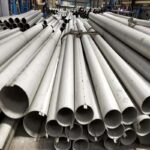
Welded pipe is formed from flat material and joined along a seam. Seamless pipe is produced without a longitudinal welded seam, commonly through hot working followed by additional sizing or cold finishing. Both routes require process control; neither name, by itself, guarantees dimensional accuracy, corrosion performance or suitability for a particular pressure duty.
ASTM A312/A312M covers seamless, straight-seam welded and heavily cold worked welded austenitic stainless steel pipe for high-temperature and general corrosive service. This scope shows why “ASTM A312” does not automatically mean seamless. State the required manufacturing route separately and identify the contractually applicable standard edition.
Start with the project specification and service conditions
Before comparing offers, confirm whether the piping specification permits both routes. If it explicitly requires seamless pipe, a welded alternative needs formal technical approval before purchase. Where both are permitted, evaluate the actual quoted product against the same requirements rather than treating the route as a quality ranking.
Provide the service fluid, design pressure and temperature, cleaning conditions and relevant environmental exposure. The responsible engineer must establish the wall thickness and applicable design rules. A schedule designation alone is not a pressure rating, and a change of production route does not remove the need for engineering review.
For example, a buyer replacing an existing spool should supply its material specification and dimensional drawing. Ordering merely “316L stainless pipe, same as installed” leaves uncertainty about wall thickness, end preparation and the evidence needed for acceptance.
Keep grade selection separate from manufacturing route
Seamless construction cannot compensate for an unsuitable alloy. Grade selection must address the service environment, including contaminants, temperature and cleaning chemicals. The low-carbon designation in 304L or 316L is also distinct from whether the pipe is welded or seamless.
Molybdenum-alloyed 316L is commonly considered where corrosion demands exceed those suited to 304L, but it is not universally resistant to chloride exposure. Outokumpu explains that 304L and 316L can be susceptible to stress corrosion cracking in warm, chloride-heavy environments. Ask for a service-specific material review where conditions are uncertain.
Write the precise grade designation into the enquiry. If dual certification is offered, request the certificate and verify that it demonstrates compliance with the specified grades and product standard. A commercial description is not a substitute for documented results.
Compare dimensions, finish and fabrication requirements
Use nominal pipe size and schedule, or an explicit outside diameter and wall thickness with units, as appropriate to the specification. Include required lengths, length tolerances, quantity and end condition. Pipe and tube descriptions are not interchangeable ordering instructions; make the dimensional basis unambiguous.
For welded pipe, identify any requirements concerning the internal weld bead or seam condition. For either route, specify the required heat-treated and surface condition. A bright appearance does not establish cleanliness or corrosion resistance, while a visually unobtrusive seam does not prove a pipe is seamless.
Tell the supplier about downstream bending, orbital welding, machining or automated fit-up. These operations may make straightness, ovality, wall variation or end squareness commercially significant. Put measurable acceptance limits in the purchase documents instead of relying on a general request for “good finish.”
Define inspection evidence before comparing prices
Ask each bidder to identify the inspections and tests included under the specified product standard and any supplementary project requirements. Distinguish the examination method, coverage, acceptance criteria and reporting obligations. An offer mentioning “tested pipe” is too broad to support a fair comparison.
Hydrostatic testing and nondestructive examinations are not interchangeable evidence for every purpose. Confirm which checks apply to the proposed product and what the governing specification allows. Extra radiography, third-party witnessing or additional testing should be agreed before the order, including responsibility for associated costs and scheduling.
Require traceability between delivered markings and material certificates. For cut lengths, agree how identification will be preserved. Request a sample certificate format and inspection plan when documentation is important to project handover, so missing evidence is discovered before dispatch.
Assess total cost and delivery on an equal basis
Welded pipe can offer commercial advantages in some size and quantity combinations, while seamless availability may suit other requirements. Neither route is always cheaper or faster. Obtain current quotations for the same grade, dimensions, condition, testing and delivery scope.
Compare cost per usable delivered length, including cutting losses, inspection, documentation, packing and freight. Record whether material is from available stock or new production, whether quantities can be supplied in one shipment, and when the quoted lead time starts. A lower material price can lose its advantage if the offer excludes mandatory inspection or requires additional fabrication.
Send a complete stainless steel pipe RFQ
Build your enquiry around these purchase details:
- Application, approved grade, product standard and edition.
- Permitted production route and any substitution approval requirement.
- Size, wall thickness, length, tolerances, quantity and end preparation.
- Heat treatment, surface condition and fabrication requirements.
- Testing scope, certification, traceability and inspection arrangements.
- Destination, packing, delivery terms and required delivery date.
Request a quotation from SOROYA PTE. LTD. by sending your specification and quantity breakdown to nancy@soroya.com.sg or WhatsApp +65 8058 3416. Identify any open technical points so the enquiry can distinguish compliant options from alternatives requiring approval.
关于 SOROYA PTE. LTD.
SOROYA PTE. LTD. 是一家总部位于新加坡的供应商,致力于满足国际不锈钢采购及供应链需求。.
总经理:南希
总经理电子邮箱:nancy@soroya.com.sg
WhatsApp:+65 8058 3416
地址:新加坡罗宾逊路14号,#08-01A室,远东金融大厦,048545