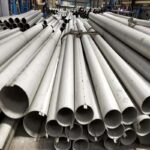
Buying stainless steel pipe and tube for food and beverage process lines is not only a matter of matching diameter and wall thickness. Industrial buyers usually need material that suits the process medium, supports welding and fabrication efficiency, and arrives with documents that satisfy quality review. If those points are left vague at RFQ stage, quotations can appear similar while hiding meaningful differences in finish, standards, traceability, and lead time.
For OEM buyers, process equipment fabricators, contractors, and distributors, the commercial goal is straightforward: source stainless steel pipe and tube that moves into production with fewer technical clarifications and fewer delivery surprises. This guide explains how to prepare a stronger purchasing basis for food and beverage line projects so suppliers can quote on a comparable and usable scope.
Start With Process Conditions and Product Contact Requirements
Many enquiries begin with a short request for 304 stainless steel tube or 316 stainless steel pipe. That is a useful opening, but it is rarely enough for a dependable quotation. Food and beverage systems may involve product contact, washdown, cleaning chemicals, temperature cycling, chloride exposure, and sanitary inspection requirements. Buyers should define the operating environment before requesting firm commercial offers.
304不锈钢管 is often reviewed for general food and beverage utility lines where corrosion exposure is moderate and buyers want a practical balance of availability, fabrication performance, and cost. 316不锈钢管 is more commonly considered when chloride exposure, aggressive cleaning regimes, brine service, or more corrosive product conditions increase the risk of pitting or surface attack. If welding is part of the fabrication route, it is also sensible to state whether low-carbon grades such as 304L or 316L are preferred.
Suppliers can quote more responsibly when they know whether the material is intended for product transfer lines, CIP circuits, utility pipework, manifolds, skids, or hygienic fabrication assemblies. End-use context helps them recommend a more workable supply route instead of relying on generic stock assumptions.
Separate Pipe, Tube, and Standard Requirements Clearly
One of the most common quotation problems in stainless steel pipe sourcing is the lack of clarity between pipe-based and tube-based specifications. Buyers may use the terms interchangeably in conversation, but suppliers still need the governing standard, tolerance expectation, and end-use requirement. If that information is missing, quotes may come back on different technical assumptions even when the grade looks identical.
For food and beverage projects, buyers should clarify whether the requirement follows a pressure pipe standard, a welded tube standard, or a hygienic process expectation tied to finish and fabrication quality. It is also useful to define outside diameter, wall thickness, length, weld condition, and whether straight lengths or cut pieces are required. A cheaper offer can become the costlier option if it does not match the actual fabrication or inspection basis.
Match Surface Finish and Weld Quality to the Cleaning Regime
Surface condition has a direct impact on usability in food and beverage applications. Some utility lines can work with standard mill finishes, while hygienic product-contact systems may require a cleaner internal surface, tighter visual consistency, or better downstream polishability. If finish is not stated in the RFQ, suppliers may quote on different assumptions while appearing to offer the same material.
Buyers should also define whether the material will be orbital welded, manually welded, expanded, bent, or fitted with hygienic couplings. If the line requires cleaner weld preparation, reduced surface discontinuities, or more controlled appearance after fabrication, that should be stated from the first enquiry. Early clarity reduces rework in both quoting and workshop planning.
Include Documentation, Traceability, and Packing in the Quote Basis
Food and beverage line projects often move through QA review, customer documentation checks, and site acceptance procedures. For that reason, paperwork should be treated as part of the supply scope rather than an afterthought. Buyers should specify whether they require mill test certificates, heat traceability, marking, EN 10204 3.1 documentation where applicable, or support for third-party inspection.
These requirements affect both lead time and final cost. The same applies to packing. Stainless steel pipe and tube intended for export or clean fabrication environments may need end protection, sleeve separation, wrapped bundles, clear piece marking, or packing that preserves surface condition through international handling. If those requirements are introduced late, quotation comparisons become less reliable.
Ask Suppliers to Quote on the Same Commercial Scope
Two quotations can show the same nominal grade and size while covering very different supply packages. One supplier may be pricing standard stock only. Another may include cleaner finish control, better certification coverage, cut-to-length service, and export-ready packing. Looking only at the first-line unit price does not show which offer is actually stronger for the project.
A buyer-focused RFQ for stainless steel tube and pipe should usually include:
- Grade and preferred variant, such as 304, 304L, 316, or 316L
- Outside diameter, wall thickness, length, and quantity for each line item
- Applicable standard or hygienic requirement for the supply basis
- Welded or seamless preference where commercially important
- Required surface finish, internal condition, and appearance expectations
- Certificate, traceability, marking, and inspection requirements
- Destination, packing basis, and target shipment timing
If the buyer can accept mixed stock lengths, substitute mill routing, or split deliveries to shorten lead time, that flexibility should be stated. Suppliers can often improve the commercial offer when they understand which points are fixed and which points can be optimized.
Compare Total Usable Value, Not Only the Unit Rate
Industrial procurement decisions improve when buyers compare total usable value instead of only the headline rate per meter or per ton. For food and beverage process lines, that means reviewing material route, finish consistency, documentation support, fabrication readiness, dispatch timing, and packing scope alongside price. A cheaper quotation loses its advantage quickly if it creates workshop delays, missing paperwork, or cleaning-related rework.
Before placing the order, buyers should confirm that the proposed supply condition fits the actual fabrication and inspection route. That short review often prevents problems during cutting, welding, installation, validation, and shipment release. In practical sourcing terms, the most useful quotation is usually the one that reduces uncertainty for purchasing, QA, and production at the same time.
If you are sourcing stainless steel pipe and tube for food and beverage process lines, send your grade, size list, finish requirement, documentation scope, destination, and delivery target for a practical quotation. For a direct enquiry, contact SOROYA PTE. LTD. by email at nancy@soroya.com.sg 或 WhatsApp +65 8058 3416. Sharing line schedules, drawings, or fabrication requirements will usually improve quotation accuracy and shorten revision time.
关于 SOROYA PTE. LTD.
SOROYA PTE. LTD. 是一家总部位于新加坡的供应商,致力于满足国际不锈钢采购及供应链需求。.
总经理:南希
总经理电子邮箱:nancy@soroya.com.sg
WhatsApp:+65 8058 3416
地址:新加坡罗宾逊路14号,#08-01A室,远东金融大厦,048545